
HayBox advantage
Three Reasons to Choose HayBox
Better feeding . More time. less money wasted. HayBox gives you more control over your feeding routine, more freedom in your day, and more value from the hay you buy.
1. Horse Health
How You Feed Matters as Much as What You Feed.
Meal feeding with long gaps without forage can increase ulcer and colic risk and create digestive stress. Unmanaged access to calorie-rich hay can make weight control difficult for easy keepers. Waste, actual intake, and metabolic health all need individual attention.
HayBox automatic feeders provide controlled, timed access to hay throughout the day and night. Choose feeding periods that support adequate forage intake and avoid prolonged fasting, while monitoring consumption and body condition.
Stomach Ulcers, Obesity, and Colic: How Feeding Can Make a Difference
Three major health concerns for horse owners are stomach ulcers, obesity, and colic. Each can have several causes, but how you feed is one factor you can manage.
Stomach Ulcers: Discomfort You May Not Always See.
A horse’s stomach produces acid continuously. Long gaps without forage reduce the chewing and saliva production that help buffer that acid. During exercise, acidic stomach contents can also splash onto the sensitive upper lining, contributing to ulcers.
Stomach ulcers can affect more than digestion. Signs may include:
Pain and discomfort, sometimes appearing as recurring mild colic.
Poor appetite, including eating less or leaving meals unfinished.
Weight loss or difficulty maintaining condition.
Changes in attitude, such as irritability or reluctance to work.
Reduced performance, keeping your horse from feeling and performing its best.
Some horses have ulcers with few outward signs. These symptoms can also have other causes, so suspected ulcers need veterinary evaluation.
How HayBox can help: Provide controlled, timed access to hay throughout the day and night to reduce long gaps without forage and encourage the chewing and saliva production that help buffer stomach acid. You can also schedule hay access before your usual riding time, giving your horse an opportunity to eat forage that helps reduce acid splash during exercise.
More consistent forage opportunities. Better support for stomach health.
Obesity: Extra Weight Can Lead to Bigger Problems.
Horses gain excess weight when they consistently consume more calories than they use. Unlimited access to calorie-rich hay can make weight management difficult, especially for easy keepers.
The effects can go beyond appearance. Excess weight can contribute to:
Insulin problems and metabolic disease, increasing the need for careful dietary management.
Greater laminitis risk, a painful hoof condition that can cause lasting damage and lameness.
Joint and muscle strain, making movement and exercise more demanding.
Additional stress on the feet, affecting hoof health and comfort.
Overheating, because excess body fat makes it harder to release heat.
Reduced stamina and performance, affecting your horse’s willingness and ability to work.
How HayBox can help: Adjust when and how long your horses have access to hay as part of a weight-management plan. Controlled, timed access throughout the day and night gives you more control over feeding while spreading forage opportunities more evenly.
Horses with insulin problems or a history of laminitis should be evaluated by a veterinarian to determine the right feeding plan, including whether tested hay is needed.
More control over feeding. Better support for a healthy weight.
Colic: A Consistent Feeding Routine Matters.
Your horse’s digestive system is built to process forage regularly throughout the day. But work, weather, and changing plans can make it difficult to keep feeding times consistent.
Colic means abdominal pain and can range from mild discomfort to a life-threatening emergency. While it has many causes, feeding management is one factor you can help control.
How HayBox can help:
Keep hay access on schedule: Work, weather, and changing plans don’t have to delay every feeding.
Reduce long gaps without forage: Provide controlled, timed access to hay throughout the day and night.
Support a consistent, forage-first routine: Provide dependable hay access, even when you’re away or your schedule changes.
Pair that routine with fresh water, appropriate hay, regular dental care, and gradual dietary changes.
HayBox is a feeding management tool, not a medical treatment. It does not guarantee the prevention of ulcers, obesity, colic, or other health conditions and is not a substitute for veterinary advice or care. Consult your veterinarian about your horse’s individual health and feeding needs.
Your plans may change. Your horses’ feeding schedule doesn’t have to.
Better Feeding Management Supports Better Horse Health.
HayBox gives you a practical way to manage feeding frequency and access through controlled, timed access throughout the day and night, helping you support a healthy, consistent feeding routine.
Horses with existing health concerns need a feeding plan developed with their veterinarian or equine nutritionist.
A feeding schedule built around your horses and your life.
Different Hay. Different Needs. Adjustable Feeding.
A new cutting, bale, or hay mix can change how quickly your horses eat and how many calories they receive. The same access time does not guarantee the same pounds eaten. HayBox lets you adjust feeding duration as your hay, your horses’ activity, and their condition change.
Introduce new hay gradually, monitor actual consumption and body condition, and use veterinary or equine nutrition guidance to keep the ration appropriate.
2. Time Savings & Convenience
Time Is Valuable. Get More of Yours Back.
How much of your day is spent making sure you’re home to feed?
Early mornings, late evenings, bad weather, and rushing back to the barn all take time. Whether you feed your horses yourself or pay someone to do it, that time has value.
Load Your Hay. Set Your Schedule. Get On With Your Day.
Depending on the model, number of horses, bale weight, and daily consumption, a load of hay may last a week or more. Check your horses, feeder, and remaining hay regularly.
Once the hay is loaded and your schedule is set, HayBox automatically opens and closes throughout the day and night.
Imagine what that could mean for your day:
Wake up knowing your horses have already had their morning feeding.
Work late without rushing home to throw hay.
Schedule feedings overnight while you sleep.
Spend less time making feeding trips and more time riding, working, or being with your family.
Head to work or out for the evening without handling dusty hay or smelling like you just walked out of a barn.
Keep feedings on schedule, even when bad weather makes getting to the barn a challenge.
More freedom in your day. A dependable routine for your horses.
3. Money Savings
When You See Hay on the Ground, Do You See Dollar Signs?
You paid for that hay. Every bit that gets trampled or contaminated is money out of your pocket.
HayBox gives you control over access to the stored hay, helping you manage feeding time and reduce opportunities for waste.
You can adjust feeding times to account for usable hay left on a clean, suitable feeding surface. Do not count soiled hay as available forage or extend closed periods at the expense of adequate forage access. By finding a schedule that works for your horses, you can make the most of each bale and work toward less waste.
What Could 35% Hay Waste Cost You?
Consider four 1,200-pound horses, each eating 24 pounds of hay per day. Together, they consume 96 pounds daily, or 17.52 tons per year.
If 35% of the hay you buy gets wasted, only 65% actually feeds your horses. To provide the 17.52 tons they eat each year, you would need to buy approximately 26.95 tons—with 9.43 tons going to waste.
Annual costHay at $450 per tonHay at $300 per tonHay your horses actually eat$7,884$5,256Additional hay lost to 35% waste$4,245$2,830Total hay purchased$12,129$8,086
That’s approximately $2,830 to $4,245 a year in hay that never feeds your horses.
Even reducing a portion of that waste could make a meaningful difference in your annual hay bill.
HayBox helps you manage access and feeding time to reduce waste and keep more of your hay dollars working for you.
This example assumes 35% of purchased hay is wasted. It is an illustration, not a typical waste rate or a guarantee of savings. Actual waste varies, and HayBox does not eliminate all waste.
Have You Ever Wished You Could Buy Big Bales to Lower Your Hay Cost?
For many horse owners, small square bales have been the practical choice. They’re easy to handle, and you can put out smaller amounts at each feeding to help manage waste.
Large bales can cost less per ton, but feeding one has often meant leaving a large supply of hay available.
HayBox makes large bales more convenient. Load a compatible feeder, then control when and how long your horses can access the hay. You can take advantage of large-bale pricing while maintaining a feeding schedule that works for your horses.
Using those same four horses, here’s what the difference in hay prices could look like:
Small square balesLarge square balesExample cost per ton$450$300Hay consumed per year17.52 tons17.52 tonsAnnual hay cost before waste$7,884$5,256
That’s $2,628 less per year.
That’s a potential saving from the difference in hay price alone—before accounting for any change in waste or feeding labor.
Your local hay prices, delivery costs, storage, and bale-handling equipment will determine whether larger bales make financial sense for your setup.
These are example prices, and 24 pounds per horse is an illustrative intake, not a feeding recommendation. Actual hay needs and prices vary.
Could Your HayBox Pay for Itself?
If you’re losing hay to waste, paying more per ton for small bales, or paying someone to feed, those costs can add up year after year.
A HayBox can help you recover its cost through a combination of:
Less hay waste: Keep more of the hay you buy available to feed your horses.
A lower cost per ton: Use compatible large bales when they cost less in your area.
Less paid feeding labor: Reduce feeding visits when your setup and care arrangements allow it.
Time back in your day: If you feed yourself, fewer feeding trips give you more time for the things you value.
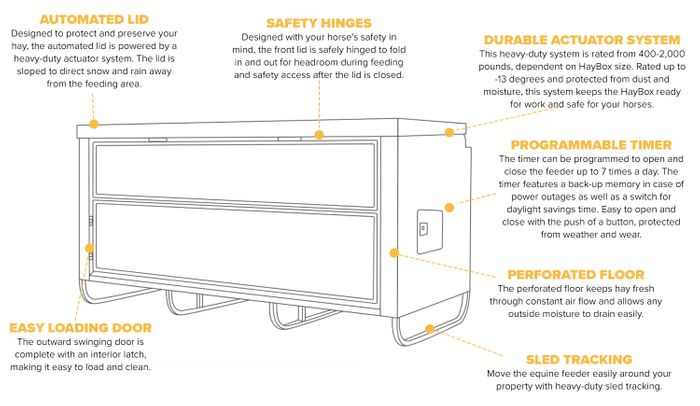
PROGRAMMABLE TIMER
The timer can be programmed to open and close multiple times day and night. The timer also features a backup memory in case of power outages, as well as a switch for daylight savings time. The system is easy to open and close with the push of a button and protected from weather and wear.
AUTOMATED LID
Designed to protect and preserve your hay, the automated lid is powered by a heavy-duty actuator system. The lid is sloped to direct snow and rain away from the feeding area.
EASY LOADING DOOR
The outward swinging door is complete with an interior latch, making it easy to load and clean.
SAFETY HINGES
Designed with your horse's safety in mind, the front lid is safety hinged to fold in and out for headroom during feeding and safety access after the lid is closed.
DURABLE ACTUATOR SYSTEM
This heavy-duty system is rated from 330-450 pounds, dependent on your HayBox size. Rated up to -13 degrees and protected from dust and moisture, this system keeps the HayBox ready for work and safe for your horses.
PERFORATED FLOOR
The perforated floor keeps hay fresh through constant airflow and allows any outside moisture to drain easily.
SLED TRACKING
Move the equine feeder easily around your property with heavy-duty sled tracking.